

Plan your build
There are two main types of planning you will need to consider for the construction of your treehouse; the physical design (practical planning) and the red tape you may have to deal with (legal planning). Both are important and can determine whether your treehouse is a good/bad or non-existent one! Practical planning will save you time and money so it's strongly advised that you work through a design in advance.
Practical planning
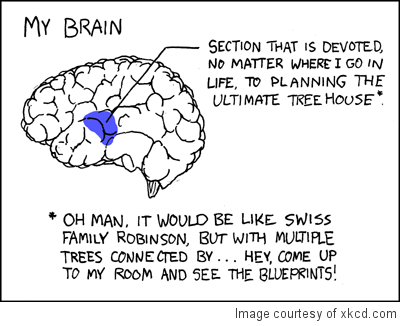
This is what most people think of when they imagine treehouse plans, and involves the physical integrity of the treehouse, its safety and the aesthetics of the design. At the beginning of a treehouse project it may seem like yet another hurdle to start creating a design on paper, especially when some amazing treehouses appear so 'organic' and naturally shaped. The reality is that setting out even a few simple sketches gives you a proper idea of the scale and look of the treehouse before you start. Get to know how your treehouse will appear in the tree, draw up some plans and check things over for potential errors. Set out a time scale and a budget for the project.
Designing a treehouse is as much about architecture and aesthetics as anything else. You will want to create a beautiful structure that fits into its settings, but at the same time has sufficient space and is structurally sound. Simplicity is a very important concept in thinking out the shape you want your treehouse to be. Consider a square treehouse with a flat roof—it is essentially a cube and is the simplest fully enclosed treehouse possible. Now imagine adding a sloping roof to this model. Notice how several new angles are introduced for only one alteration. So you must bear in mind that the more 'organic' (or non-square) your treehouse is, the more complicated the cutting list will become.
Why spend time planning?
- Get a clear idea of how the finished structure will look, allowing the appearance to be perfected.
- Save time and money by anticipating design changes on paper.
- You can more accurately determine the loads which bear on the supports, helping you choose the correct materials.
- A budget can be created from a material estimate, which may reveal features that will end up costing too much and need to be re-thought.
Create a successful design
- Be well versed on the techniques involved before you begin or you will get stuck—read through all of this site and buy a book if you need inspiration from other builders.
- Building anything in wood seems to take twice as long as you expect—allow at least three times as long with a treehouse. Set clear deadlines and adjust them as you get working on the project. This allows you to see the steps more logically and will allow you to use extra help effectively.
- Choose materials wisely and be prepared to compromise on quality for cladding materials and non-structural framing (within reason of safety), but remember that the supports must be expected to last a long time with minimal maintenance. Read the building advice pages for recommendations and be prepared to spend a little more money on this area of the design.
- Remember to budget time and money for interior decoration. This can be slow work as attention to detail is important for good results.
- Building the treehouse in sections on the ground is faster, but you need to be able to summon the extra hands and equipment required to raise the parts into the tree.
Legal planning
Usually unwelcome and sometimes an intrusive service, the legal system of planning regulations and building codes can cause many a headache for would-be treehouse builders. The myriad laws governing building works are meant to provide a uniform and measurable level of safety for occupiers and have, of course, done well to protect people from serious structural failings and health hazards in regular buildings. However, in my communications with other treehouse builders the law has—in every case I can think of—been a hindrance to the builder. In the pursuit of ever more restrictive safety regulations, the inherently nonconformist features of a treehouse are widely frowned upon and condemned by officials. This has the unfortunate result of preventing some people from ever starting their own build.
Most people's impression of building a treehouse is as a fun exercise that takes hard work but gives a huge sense of achievement and a lasting, useful addition to their garden. Involving children in various parts of the work teaches them many practical skills and gets them occupied with something creative, rather than television or video games. One of the reasons I started this website was because I think treehouses are so great that everyone should be able to learn to build one. So follow these tips to avoid having your exciting new plans stopped unexpectedly.
Keep on the right side of the law
- Build on your own land, or at least have permission.
- Discreetly ask around the neighbourhood for people's general thoughts on your treehouse.
- Very discreetly ask around the local council/governing body to determine if any laws exist regarding treehouses. Not many areas have specific laws, but if so, study them in detail.
- Keep away from boundaries. These are definite no go areas for building and should always be avoided. No part of the structure should reach within ten feet of the boundary of your property, although this distance can vary.
- Design the house to avoid having obvious privacy-infringing areas, such as large windows or balconies overlooking neighbours or roads.
- Try to choose a site that's not visible from the road. Not everyone who sees your treehouse will be impressed and anyone can make a complaint.
- Don't consider making an official planning application unless you are properly prepared. Getting a building permit is hard going for a treehouse. You will need a structural engineer who is prepared to validate the strength of the design, which is not easy. Treehouses are much more dynamic in their support and movement and so are difficult to quantify into real stress and strain measurements.
- Keeping the size and design a little restricted demonstrates that the treehouse is a 'temporary structure', the magic words. Convincing the authorities of this label is important to help negate the need for a building permit. Remember, sheds don't need permits so be prepared to describe the treehouse as such. Temporary structures usually have height restrictions (eg, fifteen feet in some places) which you are quite likely to breach building in a tree. Unfortunately there's little you can do about that, other than hiding the offending parts.
- Avoid fitted electricity and plumbing. You will be giving the impression that the building is to be used as accommodation, and that is simply not the route down which you want to travel. Your treehouse must not appear to be a potential dwelling. Many, many restrictions will apply if it does appear to be occupied or if the intent is there. You can always run an extension lead for electricity up there as another 'temporary' measure.